Bridging the Intergenerational Trust Gap
Aligning authority with future exposure

In recent years, a structural pattern of strain has become increasingly visible across political, social, and economic systems. Youth-led protests surged across multiple countries, often catalysed by accumulated grievances over corruption, economic stagnation, and political systems widely perceived as unresponsive. At the same time, global trust surveys record sustained erosion in confidence in institutions, alongside rising scepticism about whether existing systems are capable of delivering stability or opportunity. These dynamics are reinforced by rising anxiety among younger cohorts about jobs, security, and long-term prospects as rapid technological transformation reshapes labour markets and economic security.
Taken together, these developments suggest more than episodic unrest or generational dissatisfaction. They point to a structural misalignment between how authority is exercised, the time horizons over which decisions are made, and the distribution of their consequences.
When authority operates inside short cycles and exposure accumulates across decades, younger cohorts experience governance as something done to them, not with them. This is the intergenerational trust gap: the gap that opens when those who will live longest with the consequences have the weakest influence over the trade-offs that create them. Over time, this misalignment alters how authority is experienced by those most exposed to its consequences. As decisions appear increasingly distant from the conditions they shape, the relationship between governance and lived reality becomes more difficult to sustain.
Across much of the world’s political systems, authority continues to operate within short cycles. Electoral timelines, budget frameworks, and institutional mandates shape priorities, while the pressures now defining the future do not conform to those rhythms. Climate impacts, demographic change, and technological transformation unfold over decades rather than terms of office, widening the gap between political decision-making and long-term exposure.
Nearly half of the world’s population is under the age of 30, yet political leadership remains overwhelmingly concentrated among older cohorts. In many countries, this structural distance is reflected demographically: those setting policy are institutionally distant from the conditions shaping young people’s lives today. For younger generations, this distance is reflected in labour markets, housing access, and long-term economic security. Across OECD countries, young people face growing difficulty achieving financial independence and establishing themselves in labour and housing markets. Public opinion surveys across multiple regions show that large shares of people now believe that today’s children will grow up worse off than their parents.
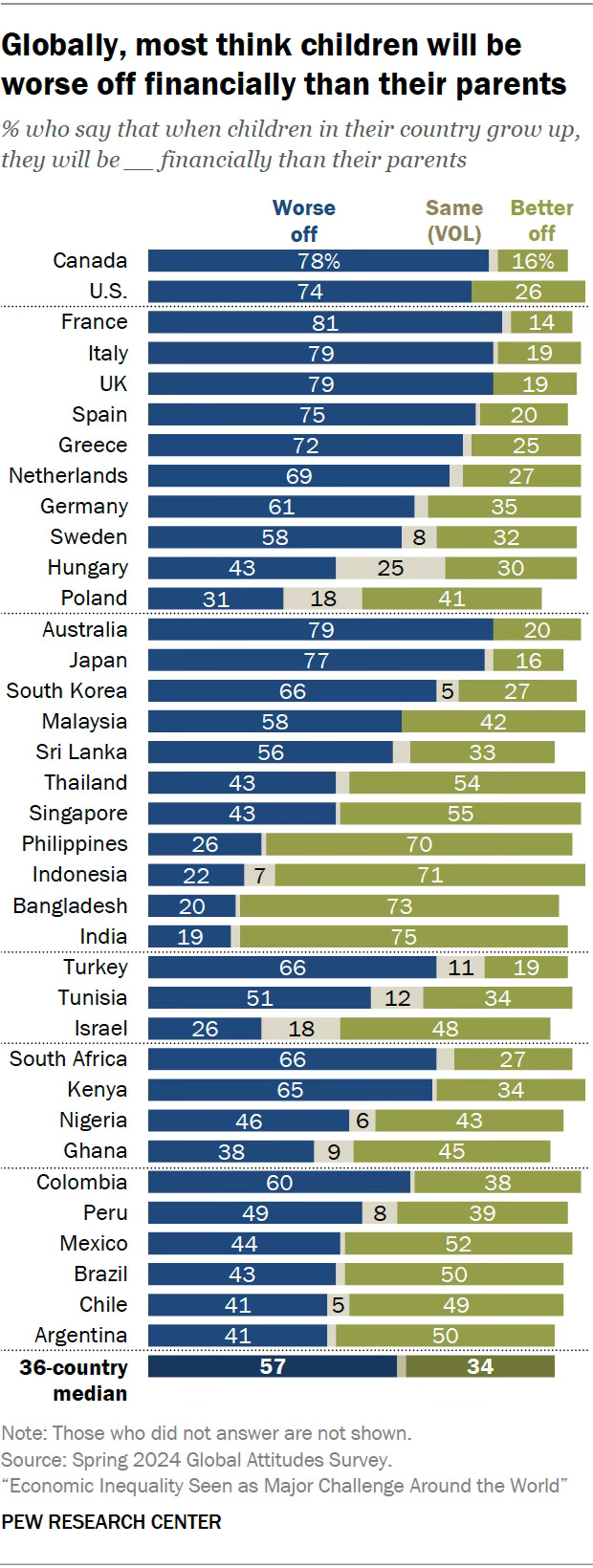
In most advanced economies, the expectation that each generation will be better off than the last, a cornerstone of the modern social contract, is no longer widely assumed. And while these patterns are most extensively documented in high-income countries, many lower- and middle-income countries face parallel or more acute pressures, including demographic expansion, labour market informality, climate exposure, and constrained social mobility, all of which widen the distance between those governing and those facing the longest-term impacts.
Trust data makes this pattern increasingly visible. Confidence in political and economic institutions among younger cohorts remains comparatively low, alongside a growing belief that established systems adapt too slowly to changing realities. This can sometimes be framed as impatience or disengagement. A more plausible reading is that it signals a legitimacy gap: in periods of rapid change, institutions are judged not only on present performance, but also by whether they appear capable of governing future risk.
From Dependence to Shared Responsibility
Participation by children and young people has traditionally been framed through a rights-based lens. International frameworks affirm that children should be heard in decisions that affect them, and that young people should have avenues for civic and political engagement. These principles are widely endorsed and formally embedded across multilateral and national governance systems, although their practical influence varies considerably.
Participation, however, now carries additional weight because of the conditions in which young people are coming of age. Many are highly educated and deeply connected, yet face early exposure to economic insecurity, environmental impacts, and technological disruption. They encounter long-term pressures early, often before institutions are compelled to respond. Excluding these perspectives limits the capacity of governance systems to identify emerging risks and assess the downstream effects of policy choices.
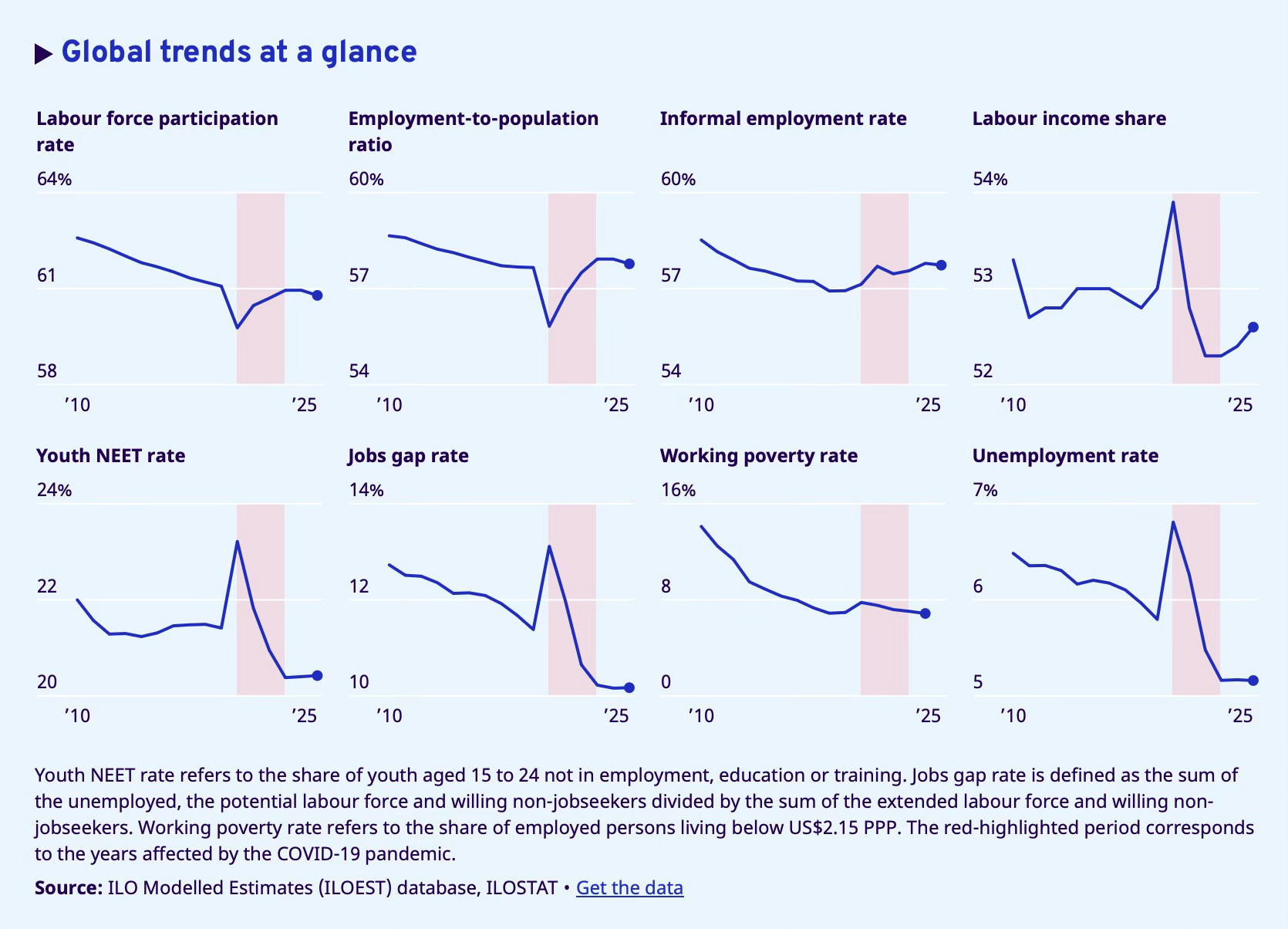
In low-trust environments, young people often operate as informal trust translators between lived reality and formal institutions. In practical terms, this means they are early-warning sensors within governance systems. They are among the earliest to register when legitimacy begins to fracture. Engaging youth therefore can strengthen the early-warning capacity of governance systems themselves.
Participation is not only procedural; it also has developmental significance. Adolescence and early adulthood mark a transition — from dependence toward agency, and from being governed to sharing responsibility. When institutions succeed at engaging young people as contributors rather than observers, that transition is reinforced. When participation is limited to expression without follow-through or visible impact on decisions, credibility of institutions and governing authorities erodes.
When Participation Lacks Agency
Opportunities for participation are now widespread. Youth councils, advisory bodies, consultations, and international forums are embedded across national and multilateral systems. Visibility has increased, but influence has not.
Their functional impact remains limited. In many contexts, participation is consultative rather than decision-shaping. Inputs are solicited, processes are documented, and presence is achieved — yet underlying distributions of authority remain unchanged. Participation fulfils procedural expectations without reliably shaping outcomes, and the link between participation and decision-making is frequently unclear.
This has cumulative effects. Low access to participation, and low-impact participation, does more than frustrate. It signals how authority actually operates — whose contributions influence decisions, and whose do not — eroding participation mechanisms by shifting them from channels for influence into spaces for expression. Under these conditions, participation cannot stabilise governance, and the withdrawal of younger cohorts should therefore be understood not as disengagement from public life, but as rational adaptation to institutional arrangements that signal limited access and responsiveness.
Why Listening Across Generations Matters
Seen in these terms, the issue is not participation volume, but alignment and impact. Intergenerational governance refers to institutional arrangements that systematically integrate those with long-term exposure into agenda-setting, deliberation, and decision-making. Many dynamics now described as generational stem from a persistent gap between where decisions are made and where long-term exposure accumulates. Authority is exercised within short institutional cycles, while consequences extend across decades, leaving those facing the longest exposure structurally distant from the arenas in which trade-offs are set.
This distance reshapes how governance is experienced. Because governance ultimately depends on a continuing supply of consent, three related dynamics become central. Trust functions as a signal citizens send about institutional performance. Legitimacy reflects their judgement about whether authority is justified. And consent is the resource institutions rely on to sustain compliance and absorb adjustment costs over time. When that willingness weakens, strain appears in compliance, in perceived legitimacy, and in the capacity to govern future risk.
Where influence is limited and exposure is long, consent becomes more conditional, tolerance narrows, and adjustment capacity shrinks. When weakening confidence, participation without effect, and rising resistance to adjustment converge, governance strain tends to surface abruptly rather than incrementally. What appears as disruption is often an indicator that existing channels are not perceived as legitimate or capable of correction. While the overwhelming majority of youth-led mobilisation remains non-violent, attitudes toward how change should occur appear to be shifting. In contexts where conventional channels are perceived as ineffective, younger cohorts show greater willingness to support more confrontational or disruptive forms of action.
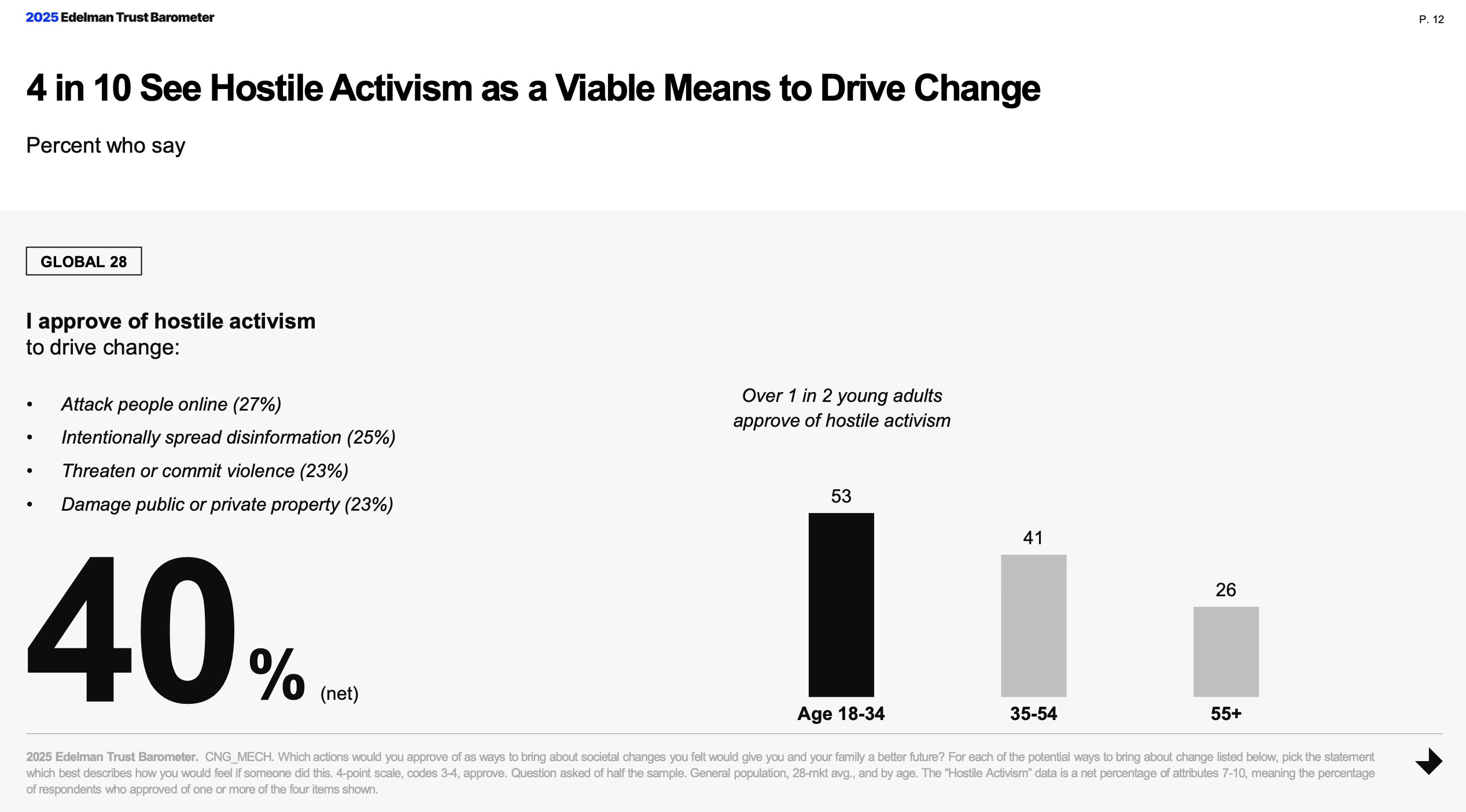
This pattern suggests that when institutional responsiveness is perceived to be low, support for more disruptive forms of engagement rises — even where mobilisation itself remains largely peaceful.
Rebalancing this relationship requires institutional arrangements that bring different generations into shared decision-making. They reconnect authority with exposure and introduce longer time horizons into decision-making before positions harden. Experience and future-oriented perspectives are considered together, widening the space for adaptation.
Applying strategic foresight can strengthen this shift by pulling long-term consequences and opportunities into present decision contexts — this is especially relevant when choices are still reversible. It can expand the range of futures considered legitimate within policy debate, rather than treating long-term risk as an externality. In practice, this would imply embedding youth-informed evidence and foresight into established policy and decision cycles such as national planning processes, budget frameworks, regulatory impact assessments, and national and multilateral priority-setting.
When Participation Becomes Governing Capacity
Participation that strengthens governance — by aligning influence with long-term exposure — has identifiable conditions.
Recognition requires that younger perspectives are treated as relevant to understanding long-term challenges, not as symbolic or supplementary inputs.
Representation requires participation to be embedded within decision-making structures, with visible pathways of influence rather than parallel consultative spaces.
Redistribution matters because material conditions — including access to education, work, and economic security — shape who is able to participate meaningfully in practice, and who experiences institutions as responsive or worth engaging with.
These dimensions are interdependent. Without recognition, participation lacks credibility. Without representation, it lacks effect. Without redistribution, it remains uneven. One pathway through which these conditions can become durable is through standards-setting within governance systems and processes, which translates intergenerational participatory norms into repeatable institutional practice.
The Governance Test of This Era
Periods of change expose how institutions function under stress. In a context marked by long-term risk, declining trust, and growing insularity, intergenerational governance and participation can no longer sit at the margins. They are increasingly central to whether institutions can sustain consent and remain functional over time. When those facing the longest futures remain peripheral to decision-making that is not solving for long-term issues, policies risk becoming less durable, and institutions less relevant.
Children and young people will live longest with the consequences of decisions made today, making their participation both a right and a practical necessity. Participation alone, however, cannot resolve the structural misalignment between authority and long-term exposure. What matters is institutional responsibility: governance arrangements that align decision-making power with those who bear consequences over time. Participation can help move institutions toward alignment, but without changes to how authority is structured, it cannot achieve that alignment on its own. Responsibility therefore rests with institutions willing to share authority across generations, and with those currently in power prepared to govern with the duration of consequences in mind, not just the duration of their mandate. This is a key governance test of this era.
References
• Chenoweth, E., & Cebul, M. (2026). Why Gen-Z Is Rising. Journal of Democracy.
• Committee on the Rights of the Child. (2009). General Comment No. 12: The right of the child to be heard. https://www.refworld.org/legal/general/crc/2009/en/70207
• Council on Foreign Relations. (2025). How global Gen Z protests are reshaping politics. https://www.cfr.org/articles/how-global-gen-z-protests-have-shocked-and-transformed-governments
• Checkoway, B. (2011). What is youth participation? Children and Youth Services Review, 33(2), 340–345. https://doi.org/10.1016/j.childyouth.2010.09.017
• Edelman. (2026). Edelman Trust Barometer 2026. https://www.edelman.com/trust/2026/trust-barometer
• Hart, R. (1992). Children’s participation: From tokenism to citizenship. UNICEF. https://participationpool.eu/wp-content/uploads/2020/05/Hart-R.-1992-Children-Participation-from-Tokenism-to-Citizenship.pdf
• Inter-Parliamentary Union. (2025). Youth participation in national parliaments. https://www.ipu.org/file/22399/download
• International Labour Organization. (2024). Global Employment Trends for Youth 2024. https://www.ilo.org/publications/major-publications/global-employment-trends-youth-2024
• Lundy, L. (2007). “Voice” is not enough: Conceptualising Article 12 of the United Nations Convention on the Rights of the Child. British Educational Research Journal. https://www.ucl.ac.uk/brain-sciences/sites/brain_sciences/files/headstart_evidence_briefing_participation_models.pdf
• OECD (2024), OECD Survey on Drivers of Trust in Public Institutions – 2024 Results: Building Trust in a Complex Policy Environment, OECD Publishing, Paris, https://doi.org/10.1787/9a20554b-en.
• OECD (2024), Society at a Glance 2024: OECD Social Indicators, OECD Publishing, Paris, https://doi.org/10.1787/918d8db3-en.
• OECD (2025), Trends Shaping Education 2025, OECD Publishing, Paris, https://doi.org/10.1787/ee6587fd-en.
• The Guardian. (2025). What drove gen Z protests that brought down governments and called out corruption? Five activists explain (30 Dec 2025). https://www.theguardian.com/global-development/2025/dec/30/gen-z-protests-corruption-five-activists-nepal-madagascar-togo-kenya-morocco-protesters
• UN DESA. (2025). UN marks 30 years of global youth action. https://social.desa.un.org/world-summit-2025/blog/un-marks-30-years-of-global-youth-action
• UNDP. (2024). Human Development Report 2023/24: Breaking the gridlock. https://hdr.undp.org/content/human-development-report-2023-24
• UNICEF Innocenti – Global Office of Research and Foresight. (2024). Voices for Impact: Meaningful youth engagement in the multilateral system. https://www.unicef.org/innocenti/reports/meaningful-youth-engagement-multilateral-system
• United Nations. (1989). Convention on the Rights of the Child, Article 12. https://www.ohchr.org/en/instruments-mechanisms/instruments/convention-rights-child
• World Bank. (2018). Fair Progress? Economic Mobility Across Generations Around the World. https://www.worldbank.org/en/topic/poverty/publication/fair-progress-economic-mobility-across-generations-around-the-world